

Table of Contents
- Why Organic Cotton Baby Outfits Are Worth the Investment
- What to Look for in Organic Baby Clothes
- GOTS Certified Baby Clothes: What the Label Really Means
- The Benefits of Organic Cotton for Babies with Sensitive Skin
- Essential Organic Cotton Baby Outfits for 2026
- How to Wash Organic Cotton Baby Clothes to Keep Them Soft
- Cost-Per-Wear and Longevity: The Smart Parent's Math
- Frequently Asked Questions
Last Updated: September 23, 2026
Why Organic Cotton Baby Outfits Are Worth the Investment
A baby's skin is roughly a third thinner than an adult's, which is why so many parents now search for the best organic cotton baby outfits 2026 has to offer instead of grabbing whatever is cheapest. This guide from Tots & Trends by Morgan covers certifications, fabric weights, and cost-per-wear math so you can buy fewer, better pieces.
Organic cotton is grown without synthetic pesticides or fertilizers, then processed with restricted chemical inputs.
What to Look for in Organic Baby Clothes
Two things separate genuinely good organic baby clothes from marketing claims: third-party certification and fabric weight. Skip either and you're paying a premium for a label.
Certifications and Standards
GOTS (Global Organic Textile Standard) matters most. It covers the entire supply chain, from harvesting the cotton to the dyes and finishes on the finished garment.
Fabric Weight and Breathability
Fabric weight is measured in grams per square meter (GSM). Lightweight knits around 150-180 GSM suit summer and layering; mid-weight 180-220 GSM suits sleepwear and cooler months.
GOTS Certified Baby Clothes: What the Label Really Means
GOTS certified baby clothes meet a standard covering organic fiber content, restricted chemical inputs, wastewater treatment, and fair labor conditions throughout the supply chain. It's not a single-farm promise; it's a chain-of-custody audit.
The Benefits of Organic Cotton for Babies with Sensitive Skin
Most guides stop at "organic cotton is gentler." That doesn't help a parent whose baby has been diagnosed with eczema or contact dermatitis. Here's the mechanism-level version.
Why the Fiber Itself Matters
A baby's stratum corneum, the outermost skin barrier, is thinner and more permeable than an adult's and doesn't fully mature until roughly the first year. Anything left on a fabric, a dye molecule, a formaldehyde-based finish, softener residue, has a shorter path to underlying tissue.
Organic Cotton vs. Bamboo vs. Synthetic Blends
This is the comparison parents of reactive-skin babies actually need.
- Bamboo viscose is soft, but the viscose process uses solvents, and residual sulfur compounds have been documented in poorly controlled supply chains. Bamboo lyocell (closed-loop) is cleaner, but it's often blended with spandex, reintroducing the synthetic-contact problem.
- Polyester and polyester-cotton blends trap heat and moisture against the skin. For an eczema-prone baby, that moisture softens the skin barrier further and creates a favorable environment for flare-ups.
- Conventional cotton can carry residues from chlorine bleaching, azo dyes, and formaldehyde-based easy-care finishes, unnecessary variables when you're trying to isolate a trigger.
What 'Sensitive Skin Tested' Actually Means
A brand claiming "sensitive skin tested" should name the standard. The two most common:
- OEKO-TEX Standard 100, which tests finished textiles for harmful substances and has a stricter "Product Class I" tier specifically for baby articles.
- GOTS, which restricts the input chemicals allowed at every processing stage and requires wastewater treatment.
A Practical Patch Test
Before committing a full wardrobe to a new brand, buy one piece and test it: wash once in fragrance-free detergent, let your baby wear it briefly against bare skin, and watch the contact areas (chest, back of neck, inner thighs) over 24 hours. It won't catch every trigger, but it catches the obvious ones before you invest in a full set.
Essential Organic Cotton Baby Outfits for 2026
A workable newborn wardrobe doesn't need forty pieces. It needs the right eight to twelve, chosen for how you'll actually use them.
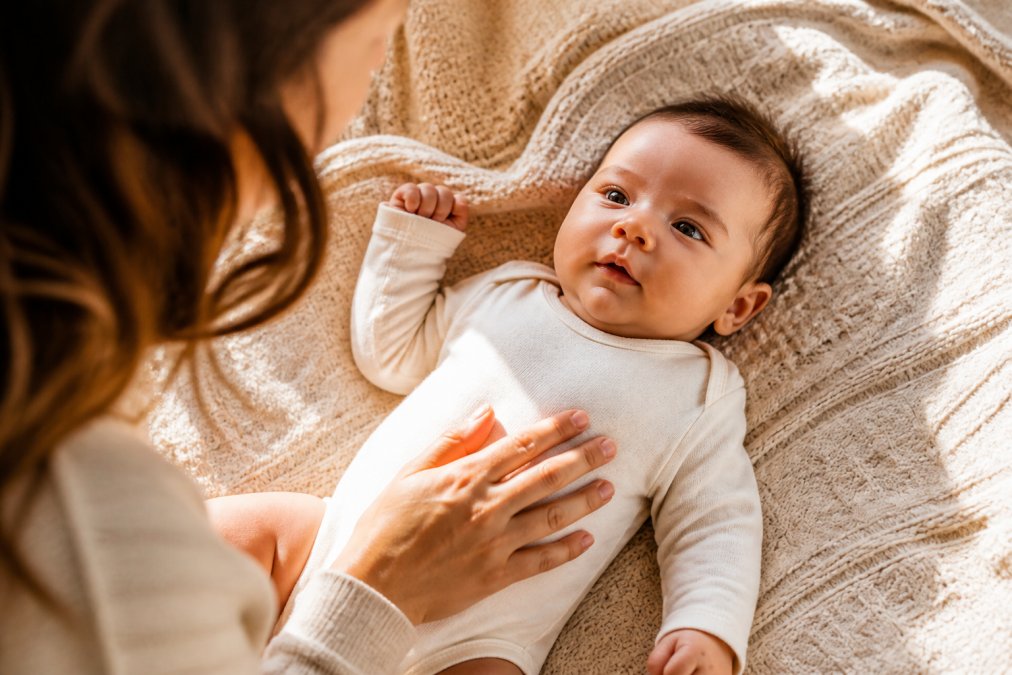
Everyday Play
For daily wear, prioritize pieces that survive crawling, spit-up, and repeated washing.
- Snap closure bodysuits in mid-weight cotton, three to five of them
- Pull-on leggings with a soft, wide waistband that won't dig in
- Short-sleeve tees in lighter knits for layering
- Zippered footies for quick changes on cold mornings
Sleep and Comfort
Sleepwear should be breathable above all else. Overheating is a bigger concern than chill for most babies indoors.
Special Occasions
Milestone photos, first birthdays, and family events call for pieces that look considered without being uncomfortable. A well-cut organic cotton outfit in a soft neutral or low-impact dye reads beautifully in photos and still lets a baby move.
This is where curation pays off.
| Outfit Type | Best For | Key Feature | How Many to Own |
|---|---|---|---|
| Snap bodysuit | Everyday play | Easy diaper access | 3-5 |
| Pull-on leggings | Crawling, play | Wide soft waistband | 3-4 |
| Knot gown | Night changes | No snaps, quick access | 2 |
| Zippered footie | Sleep, cool rooms | Full coverage, breathable | 2-3 |
| Occasion set | Photos, events | Considered cut, soft dye | 1-2 |
How to Wash Organic Cotton Baby Clothes to Keep Them Soft
Learning how to wash organic cotton baby clothes properly determines whether they stay soft for a year or turn stiff in a month. The fabric isn't fragile, but it responds badly to heat and harsh detergent.
- Wash cold on a gentle cycle. Hot water causes shrinkage and dulls natural fibers.
- Use a mild, fragrance-free detergent. Enzymes and optical brighteners leave residue that stiffens cotton.
- Skip fabric softener. It coats the fibers and reduces breathability, which is the whole reason you bought organic cotton.
- Tumble dry low or line dry. High heat is the fastest way to shrink a garment out of fit.
- Wash inside out to protect any print or low-impact dye.
Cost-Per-Wear and Longevity: The Smart Parent's Math
Cost-per-wear is purchase price divided by the number of times a garment is actually worn. Here's the version that actually changes a buying decision.
Running the Math
Say a budget bodysuit costs $8 and survives about 15 washes before the seams give or the fabric pills, roughly $0.53 per wear. A well-made organic cotton bodysuit at $24 that holds up through 80 washes comes out to $0.30 per wear. The expensive one is cheaper per use, and still soft at the end.
What Actually Drives Wear Count
Three things push a garment's usable life up:
- Fiber staple length. Longer-staple cotton (often labeled Pima or Supima) resists pilling because fewer fiber ends work loose.
- Knit density and seam construction. Flatlock seams and reinforced crotch snaps survive repeated stretching better than standard serged seams.
- Shrinkage resistance. A garment that shrinks out of fit after five washes has a wear count of five, no matter how well it's made. Pre-shrunk organic knits hold their size; untreated ones don't.
The End-of-Life Angle Most Guides Skip
Almost no roundup tells you what to do with organic cotton when your baby outgrows it, and that's where the sustainability claim either holds up or doesn't.
- Textile recycling. Undyed or naturally dyed, untreated organic cotton is a better feedstock for fiber-to-fiber recycling because it lacks the synthetic finishes and blended fibers that complicate the process. Programs accepting post-consumer textiles generally prefer single-fiber, untreated garments.
- Composting. 100% organic cotton with no synthetic finish, no elastane, and no plastic-based thread breaks down in a home compost pile over months, not years. Check the care tag first: a 95/5 cotton-spandex blend won't compost cleanly.
- Resale and hand-me-downs. Organic cotton holds resale value better than conventional because the certification travels with the garment. A GOTS-certified piece with a legible tag resells more easily than an unlabeled one.
Verifying the 'Organic' Claim Before You Pay
A logo alone isn't proof. Use this checklist:
- Find the license number. GOTS-certified products carry a license number on the tag or product page. Look it up on the certifying body's public database.
- Check the certifying body. GOTS, OEKO-TEX, and USDA Organic are the names you'll see. A brand that can't name its certifier is a red flag.
- Ask for the supply chain. A brand that can say where the cotton was grown, spun, and sewn can verify its own claims. If the answer is vague, the claim probably is too.
- Watch for 'made with organic cotton.' That phrasing can mean as little as 5% organic content. GOTS requires at least 70% organic fiber for the "made with" label and 95% for the "organic" label.
A capsule approach, fewer pieces chosen well and rotated often, beats a drawer full of cheap cotton every time, and it's the only approach where the cost-per-wear math actually works in your favor.
Frequently Asked Questions
Why is GOTS certification important for baby clothing?
GOTS certification ensures organic cotton is grown without synthetic pesticides and processed without toxic chemicals. It also includes strict social and environmental criteria, so you can trust the outfit is safe for your baby's sensitive skin and made ethically.
What are the benefits of organic cotton for newborns with sensitive skin?
Organic cotton is grown without harsh chemicals, making it less likely to cause irritation. Its natural fibers are soft and breathable, helping regulate temperature and reduce the risk of rashes. Many parents find organic cotton outfits are gentler on newborns' delicate skin.
How do I wash organic cotton baby clothes to keep them soft?
Wash in cold water on a gentle cycle with a mild, fragrance-free detergent. Avoid fabric softeners and bleach, which can break down fibers. Tumble dry on low or line dry. Following these steps helps maintain softness and extends the life of the garment.
Is organic cotton more durable than conventional cotton for baby outfits?
Organic cotton often has longer fibers because it's not exposed to harsh chemicals, which can make it more durable. It withstands repeated washing better, retaining shape and softness, so it can be more cost-effective over time.