

Table of Contents
- Start With a Plan: Measure, Sort, and Set Goals
- How to Declutter Kids Clothes Without the Meltdowns
- Kids Closet Storage Ideas That Actually Maximize Vertical Space
- Shared Kids Closet Organization for Two or More Children
- Montessori Closet Setup for Independent Kids
- Seasonal Rotation and Maintenance That Keeps the Closet Working
- Common Mistakes That Undo a Kids Closet Makeover
- Frequently Asked Questions
Last Updated: September 25, 2026
Start With a Plan: Measure, Sort, and Set Goals
Organizing a kids closet starts with a tape measure, not a shopping cart. Buying bins first leads to returns, mismatched shelves, and a closet that still feels crowded.
Take Measurements and Map Your Space
Grab a tape measure and note four numbers:
- Total closet width, in inches
- Hanging rod height from the floor
- Shelf depth and clearance above it
- Door swing and floor space in front
Note whether the closet has one rod or two, a second rod doubles hanging space for short items once your child can reach it.
Set a Realistic Goal for the Closet
A kids closet should hold what fits now, let your child reach their own things, and survive a busy week without a full reset. Write your goal in one sentence, for example, "My six-year-old can pick out her own outfit in under five minutes." That goal decides every choice that follows.
How to Declutter Kids Clothes Without the Meltdowns
The fastest way to declutter kids clothes is to make decisions once, in one sitting, with a simple rule. Sort with older kids present; do the first pass alone for toddlers.
Start with three piles:
- Fits now and gets worn
- Too small or never worn
- Not sure (out of season, sentimental, or waiting on a growth spurt)
Use the 3-3-3 Rule to Decide What Stays
The 3-3-3 rule is a simple decluttering method: keep three everyday outfits, three play or school outfits, and three special-occasion pieces per season.
Kids Closet Storage Ideas That Actually Maximize Vertical Space
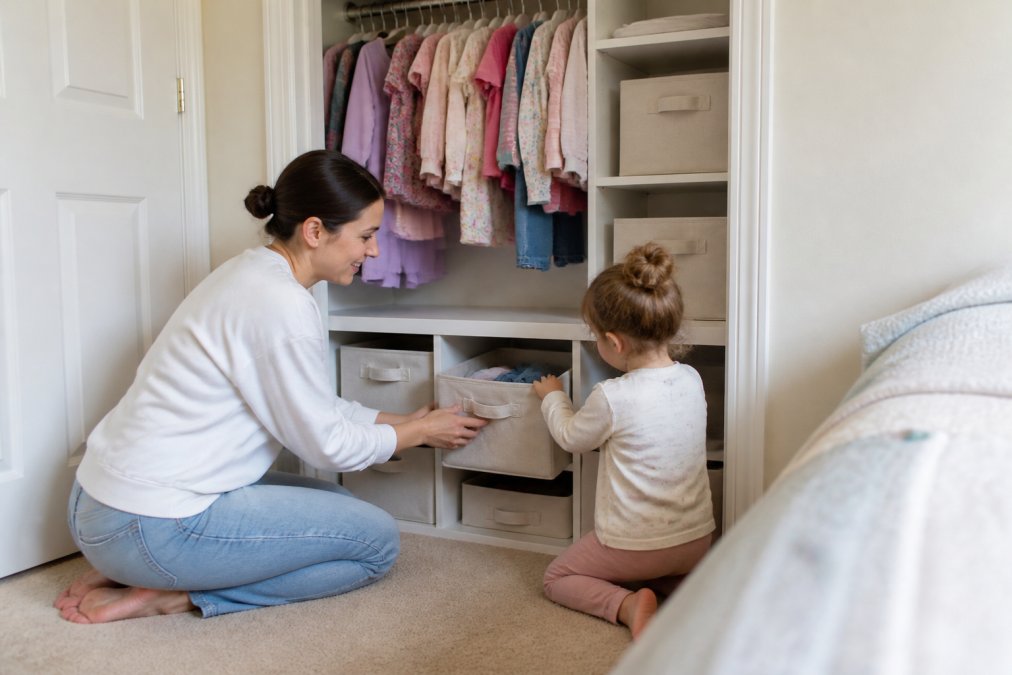
The best kids closet storage ideas use height, not floor space. Most closets have unused room above the rod and dead space below it, but the right layout depends on your child's age and reach.
Match the Layout to Your Child's Age
A closet that works for a two-year-old will frustrate a ten-year-old. Use these age bands as a starting point:
- Ages 2-4: One low rod at roughly 28-32 inches from the floor, one open bin per clothing category at knee height, and no shelving above 48 inches except adult-only storage. A toddler's reach tops out around 36-40 inches, so daily items must sit below that line.
- Ages 5-7: A low rod at 36-40 inches, a second rod above at standard height (about 66-68 inches) for out-of-season items, and two or three cubbies at waist height. Kids this age can manage a two-step routine: pull open a bin, drop in the item.
- Ages 8-12: A standard-height rod (66-68 inches) plus a low rod for pants and shorts, a shelf at 48 inches for folded stacks, and labeled bins for socks, underwear, and accessories. Pre-teens can handle lidded bins and drawer organizers for a cleaner finish.
Budget-Friendly Hardware That Doubles Hanging Space
You do not need a custom closet system to add a second rod. A few low-cost options work in almost any closet:
- Rod-doubling kits that clamp onto an existing rod and hang a second bar below it, typically under $25 and tool-free.
- Adjustable tension rods for lightweight items like skirts, shorts, and toddler dresses. Look for a rubberized end cap so the rod does not scar the wall.
- Wire shelving add-ons that hook over an existing shelf to create a second tier. They are the cheapest way to add cubby space but can sag, so keep them for folded knits and pajamas.
- Over-the-door shoe organizers repurposed for hair accessories, socks, or small toys, zero floor footprint and cheaper than a fabric bin set.
Measure first, then buy the smallest intervention that fits.
Bins, Baskets, and Cubbies That Work at Kid Height
Open bins beat lidded ones for young children. A lid is one more step between your child and putting their clothes away.
Use these options at kid height:
- Fabric bins for pajamas, socks, and underwear, look for a soft-sided bin with a reinforced handle so it survives being dragged.
- Low cubbies for folded shirts and pants, a nine-cube organizer at 36 inches tall keeps the top row within reach for most five-year-olds.
- Small baskets for hair accessories or small toys, shallow beats deep because kids can see everything at a glance.
- Shelf dividers to keep folded stacks upright, they prevent the classic "one shirt pulled, whole stack falls" problem.
Claim the Vertical Space Above the Rod
The zone above the rod is the most wasted real estate in a kids closet. Use it for:
- Out-of-season clothing in labeled, stackable bins sized to the shelf depth.
- Hand-me-downs sorted by size, so next year's clothes are ready without a full overhaul.
- Keepsakes in a single archival box per child, one box, not a growing pile.
Shared Kids Closet Organization for Two or More Children
Shared kids closet organization works best when each child gets their own vertical column, not a shared rod. Columns prevent the "that's my side" arguments before they start.
- Their own hanging rod section
- Two or three labeled bins
- One shelf or cubby stack
Montessori Closet Setup for Independent Kids
A Montessori closet setup puts everything a child needs at their own height so they can dress themselves. The goal is independence, not decoration.
Build it with these steps:
- Lower the hanging rod to your child's shoulder height
- Add one low shelf or cubby at knee height
- Place a small step stool for higher items
- Limit daily choices to a few complete outfits
- Use open baskets instead of closed drawers
Seasonal Rotation and Maintenance That Keeps the Closet Working
A closet stays organized when you rotate it on a schedule, not when you reorganize it once. Most guides say to "store out-of-season clothes" without explaining how to do it in a small closet footprint.
The Two-Rotation Workflow, Step by Step
Plan two full rotations a year, spring and fall, each a 45-minute project:
- Pull everything out and lay it on the bed, sorted into in-season and out-of-season piles.
- Try on the in-season pile with your child present. Anything too small goes straight into a donate or hand-me-down bag, do not put it back "just in case."
- Pack the out-of-season pile into clear or labeled bins by size and season. Write the size and season on two sides so you can read it whether the bin is stacked vertically or horizontally.
- Vacuum-seal bulky items like winter coats and snow pants if space is tight. One vacuum bag can compress a coat to roughly a third of its hanging volume, freeing an entire shelf.
- Reload the closet with only in-season items, using the age-appropriate layout above.
- Store the out-of-season bins outside the closet, under a bed, on a high garage or utility-room shelf, or in a labeled basement tote. The closet should hold only what fits today.
Where to Store Out-of-Season Clothes in a Small Space
If you do not have a garage or basement, you still have options:
- Under-bed storage bags, flat, zippered bags that slide under a twin or full bed. One bag holds roughly a season of clothes for one child.
- Top-shelf bins, the highest shelf in any closet, including an adult closet, works for out-of-season kids' clothes if labeled by size and season.
- Stackable clear totes in a hall closet or utility room, clear sides let you see contents without opening every bin.
- Vacuum bags inside a single large tote, compression plus a rigid outer container so the bag does not get punctured.
Maintenance Cadence by Age
The right maintenance rhythm depends on how much your child can do alone:
| Task | When | Time Needed | Who Does It |
|---|---|---|---|
| Swap out-of-season clothes | Spring and fall | 30-45 minutes | Adult, with child helping |
| Check fit on daily items | Monthly | 10 minutes | Adult |
| Restock bins and refold | Weekly | 5-10 minutes | Child (ages 5+) with adult check |
| Clear too-small items | Every 3 months | 15 minutes | Adult, child sorts |
| Wipe down shelves and bins | Every 6 months | 10 minutes | Adult |
Build the Habit, Not Just the System
A quick weekly reset keeps the system alive. Have your child return their own items to the labeled bins, five minutes that builds the habit early. Pair it with an existing routine, like Sunday evening before the school week.
Common Mistakes That Undo a Kids Closet Makeover
The biggest mistake is organizing for your own height instead of your child's. A beautiful closet only an adult can use will fail within a week.
Watch for these traps:
- Buying bins before measuring. Wrong sizes waste money and space.
- Using lidded boxes at floor level. Kids skip them and pile clothes on top.
- Keeping too many clothes. More options mean slower mornings and more mess.
- Skipping labels. Unlabeled bins become junk drawers fast.
- No rotation schedule. Without seasonal swaps, the closet fills with clothes that no longer fit.
Frequently Asked Questions
What is the 3-3-3 rule for decluttering kids' clothes?
The 3-3-3 rule asks you to pull out three items to toss or donate, three to relocate to another room, and three to put back in their proper spot. Applied to a kids closet, it turns an overwhelming pile into a quick 10-minute task. Many parents run it once a season, right before a clothing rotation, so the closet never builds up clothes that no longer fit.
How often should you rotate seasonal clothing in a child's closet?
Twice a year works for most families, with a quick check at each growth spurt. Store out-of-season pieces in labeled bins on the top shelf, and pull them down when temperatures shift. Kids under five often need a third rotation because they grow through sizes faster. A short mid-season pass catches items that suddenly stopped fitting.
What are the best storage solutions for small kids' closets?
Low cubbies, stackable bins, and a second hanging rod set at kid height do the most work in a small space. Add shelf dividers to stop folded stacks from toppling, and use over-the-door hooks for backpacks and jackets. Clear or labeled bins help kids find things without pulling everything out, which keeps the closet tidier between cleanouts.
How can you organize a shared closet for multiple children?
Split the closet into clear vertical zones, one per child, and label each zone with a name or color. Give each kid their own bin, hanging section, and hook so nothing overlaps. If ages differ a lot, put the younger child's items on the lower rod and cubbies. A shared kids closet organization system works best when every item has one obvious home.