

Table of Contents
- Why Weight and Height Matter More Than Age
- How to Measure Kids for Clothes at Home
- Reading a Kids Clothing Size Chart by Age
- The Visual Fit Checklist: Signs It's Time to Size Up
- Fabric Stretch, Shrinkage, and Sensory-Friendly Fit
- Why Best Non Toxic Baby Clothing Brands Fit Differently
- Second-Hand Clothing: Sizing Nuances to Know
- Conclusion: Dressing for Comfort and Confidence
- Frequently Asked Questions
Last Updated: September 13, 2026
Why Weight and Height Matter More Than Age
Age-based sizing is a starting point, not a guarantee when it comes to kids clothes fit. A child's height and weight predict fit far better than the tag: two five-year-olds can differ by several inches and still share a size label, the same "4T" can hang loose on one child and pull across the chest on another.
The CDC growth charts track height, weight, and body mass index by percentile, which gives you a realistic picture of where your child sits relative to peers. When your child's height lands above the 75th percentile for their age, expect to size up before the birthday rolls around.
Age charts are fast; height and weight checks are accurate. Age sizing works for loose basics; for anything fitted, measured wins.
How to Measure Kids for Clothes at Home
Measuring at home takes about five minutes and a soft measuring tape. Measure over light clothing or a bodysuit, keep the tape level and snug but never tight, and write the numbers down. Recheck every two to three months, young children can grow a full size in one season.
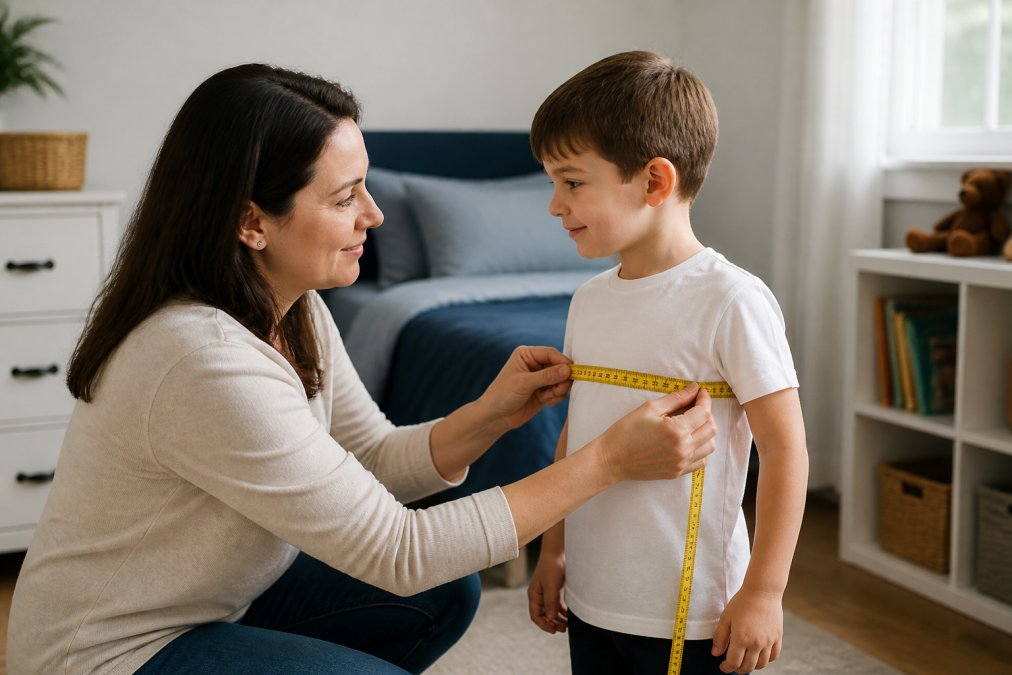
Step-by-Step: Chest, Waist, and Height
- Chest: Wrap the tape around the fullest part of the chest, under the arms and across the shoulder blades. Keep it level all the way around.
- Waist: Find the natural waistline, which sits above the navel and below the ribcage. Have your child breathe normally rather than suck in.
- Height: Stand your child against a wall without shoes, heels together, and mark the top of the head. Measure from floor to mark.
- Inseam (optional): Run the tape from the crotch seam to the ankle bone for pants and rompers.
- Record it: Note the date alongside each measurement so you can spot growth trends.
Tips for Measuring with a Soft Tape
Two common mistakes: measuring over bulky clothing, which adds phantom inches and leads to oversized purchases, and pulling the tape tight, which flattens the body and understates the true chest circumference.
Reading a Kids Clothing Size Chart by Age
A kids clothing size chart by age maps age ranges to standard body measurements, typically height, weight, chest, and waist. Use it as a starting filter, then confirm against your child's actual numbers.
Most charts group children into infant, toddler, and big kid sizes, 12M, 2T, 4T, 6X. The letters matter: a "T" cut leaves room for a diaper and a rounder toddler belly, while big-kid sizes assume a slimmer, taller frame.
| Size Label | Typical Age Range | Key Measurement to Check | Fit Note |
|---|---|---|---|
| 12M-24M | 12-24 months | Height, weight | Roomy through the seat for diapers |
| 2T-5T | 2-5 years | Waist, chest | Extra length, adjustable waistbands |
| 6-6X | 6-7 years | Height, inseam | Slimmer cut, less diaper room |
| 7-8 | 7-8 years | Height, chest | Closer to adult proportions |
Baby vs. Big Kid Sizing: What Changes
Baby sizing prioritizes access and room: snaps, envelope necks, generous seat depth. Big kid sizing shifts toward proportion, adding sleeve length, defined shoulders, and slimmer waists.
The transition trips up most parents: a child moving from 5T to a size 6 often finds the new size longer but narrower, which reads as "too small" when it is actually cut correctly.
The Visual Fit Checklist: Signs It's Time to Size Up
Your eyes catch fit problems faster than any chart. Work top to bottom, because fit failures cascade: a too-small shoulder pulls the garment out of alignment, showing up as a riding hem or twisted side seam.
The Top-Down Diagnostic
Shoulders and neckline. The shoulder seam should land at the outer edge of the shoulder bone, not inside it. A seam sitting toward the neck means the chest is too narrow and will pull when your child reaches forward. A neckline that gapes when they bend over is too wide; one that leaves a red ring or digs into the collarbone is too small.
Chest and torso. Horizontal pull lines from the armpit or across the chest mean the fabric has run out of room. On a button-front shirt, a gap between buttons, "button pull", is the clearest sign the chest is too tight. On a t-shirt, side seams curving inward toward the waist mean it is straining.
Sleeves. The cuff should reach the wrist bone with the arm relaxed at the side. A sleeve ending above the wrist bone means the arm is longer than the cut allows; a shoulder seam below the shoulder point means the sleeve is too long and will bunch at the elbow.
Waist and rise. You should slide one finger, about half an inch, between the waistband and your child's body without digging in. A waistband that leaves a red mark after an hour, or that your child constantly tugs down, is too tight. One that slides down when they walk is too loose, not too small.
Hem and length. Tops should cover the pants waistband when arms are raised; pant hems should break once at the shoe, not pool over the foot or stop above the ankle bone. A hem that rides up past the waist with arms overhead means the torso is too short.
The Movement Test
Static fit lies. Run your child through a 30-second movement sequence:
- Arms overhead: Does the hem stay below the waist? If it rides up, the torso is too short.
- Deep squat: Does the seat pull tight or the waistband gap at the back? Either means the rise is wrong.
- Reach across the body: Does the shoulder seam shift toward the neck? That is a width problem, not a length problem.
- Sit cross-legged: Do the knees feel binding? If your child winces or resists, the pants are too narrow through the thigh.
A garment that passes the static check but fails the movement test is still the wrong size. Children spend most of their waking hours moving, so fit has to hold up in motion, not just in the mirror.
The After-Wear Check
The most reliable diagnostic happens when the clothes come off:
- Red marks, indentations, or chafing at the waist, shoulders, or underarms
- Elastic marks that persist more than 15 minutes after undressing
- Your child tugging at the collar, waistband, or cuffs during the day
- A sudden refusal to wear a piece they used to love, often a fit complaint a child cannot articulate
A snug fit that leaves red marks or limits arm movement is not a style preference, it is a sizing error. Persistent pressure points and restricted movement signal the garment is too small, and children will resist wearing it, sometimes by melting down over an outfit that looks fine on the hanger.
When to Size Up vs. When to Adjust
Not every fit problem calls for a new size. If length is the only issue, short sleeves, pants grazing the ankle, rolling cuffs or taller socks buys a few weeks. If width through the chest, shoulders, or seat is the problem, size up: you cannot stretch a garment with no room to give. If the waist alone is tight, try adjustable waistbands or drawstrings first, since a full size up may fix the waist and leave everything else baggy.
Fabric Stretch, Shrinkage, and Sensory-Friendly Fit
Fabric changes fit as much as the size label. Knits with elastane stretch to accommodate a growth spurt; stiff wovens hold their shape with almost no give. Cotton typically shrinks after the first hot wash, so a garment that fits out of the bag may feel tighter within a week.
For children with sensory sensitivities, fit is not cosmetic, a scratchy seam, tight cuff, or tag rubbing the neck can make an otherwise comfortable outfit unwearable. Look for flat seams, covered waistbands, and soft natural fibers, and size up rather than down when in doubt.
The American Academy of Pediatrics guidance on clothing and skin comfort notes that breathable fabrics and loose, non-binding fits help reduce irritation for children with sensitive skin.
Why Best Non Toxic Baby Clothing Brands Fit Differently
Brands prioritizing non-toxic, natural materials often cut differently from mass-market labels. Organic cotton and untreated fibers have less synthetic stretch, so a "true to size" fit from these makers can run slightly smaller than a comparable mainstream piece.
That is a trade-off, not a flaw: fewer chemical finishes and better breathability, but none of the forgiving stretch of a synthetic blend. When shopping the best non toxic baby clothing brands, check the fabric content and add a half size of growth allowance for stiff wovens.
We provide detailed product descriptions, including fabric composition, to help you predict how a piece will fit before it arrives.
Second-Hand Clothing: Sizing Nuances to Know
Thrifted and hand-me-down clothing carries sizing quirks new garments do not, and the printed tag is often the least reliable information on the piece. It may have shrunk in a previous owner's dryer, stretched at the knees and elbows, lost waistband elasticity, or pilled in a way that changes how it drapes. Treat the tag as a hint and the garment as the source of truth.
Why the Tag Lies
Cotton knits commonly shrink 3 to 5 percent after a first hot wash and dry, and untreated cotton can lose more, a 4T tee measuring 15 inches across the chest when new may hit 14 inches after a year, functionally a 3T. Ribbed cuffs and waistbands lose recovery and sag. Synthetic blends hold size better but pill and thin, changing how they hang without changing the measurement.
The Flat-Measurement Method
The fastest way to judge kids clothes fit on a second-hand piece is to measure it flat against a garment your child already wears and fits well. You do not need a size chart, you need a known-good reference.
- Lay the garment flat on a table, smoothing out wrinkles without stretching the fabric.
- Measure chest width from one armpit seam straight across to the other. Double it for the full circumference.
- Measure body length from the highest point of the shoulder (not the collar) down to the hem.
- Measure the waist across the relaxed waistband, then stretch it gently to see the maximum. Note both numbers.
- Measure inseam from the crotch seam to the leg hem.
- Compare each number to the same measurement on a piece your child currently wears. A match within half an inch is usually safe; more than an inch narrower in the chest or waist is a pass.
Keep a note on your phone with the flat measurements of your child's best-fitting tee, pants, and long-sleeve top. It turns any thrift rack into a five-second yes-or-no decision and beats any size conversion chart, because it accounts for how the specific garment has aged.
What to Inspect Before You Buy
Measurements alone do not tell the whole story. Inspect any second-hand piece for:
- Waistband and cuffs: Stretch the elastic and release it. If it does not snap back quickly, the recovery is gone and the piece will sag.
- Knees and elbows: Look for thin spots, shiny patches, or permanent bagging. Stretched knees will not return to shape.
- Seams and hems: Check for popped stitches, unraveling hems, or repaired seams that may fail under movement.
- Pilling and fading: Heavy pilling on the seat or underarms signals wear that will accelerate. Fading alone is cosmetic unless the fabric has thinned.
- Stains and odors: Set-in stains often reappear after a wash, and lingering odors can indicate mildew in the fibers.
- Tags and care labels: Note the fiber content. A cotton piece that has already shrunk once will shrink again if you wash it hot.
Washing and Expecting a Second Shrink
Wash second-hand items before the first wear, for hygiene and to see how the fabric behaves. For cotton or cotton-heavy blends, wash the way you plan to going forward, hot water and a hot dryer means another 3 to 5 percent shrinkage. To preserve the current fit, wash cold and hang or lay flat to dry. For anything with elastane, avoid high dryer heat, which breaks down stretch fibers fastest.
When Second-Hand Is a Bad Bet
Some pieces are not worth the risk at any price. Skip anything with a waistband that has lost its snap, shiny thin knees, or unidentifiable fiber content. Skip heavily pilled fleece and anything strongly musty, since mildew is hard to remove. And skip pieces measuring more than an inch off your child's current chest or waist fit, no amount of washing adds that room back.
Second-hand sizing is not about reading the tag, it is about reading the garment. Measure it flat, compare it to a known-good piece, inspect the elastic and high-wear zones, and wash it the way you plan to keep washing it. Do that and hand-me-downs become the most reliable fit in your child's drawer, not the least.
Conclusion: Dressing for Comfort and Confidence
Getting fit right is a moving target: children grow in unpredictable bursts, brands cut to their own standard sizing, and fabric behaves differently piece to piece. The parents who nail it measure every few months, trust the visual checklist over the tag, and buy with a little room to grow.
That is our approach at Tots & Trends by Morgan. Our curated selection focuses on style, quality, and comfort, with on-trend pieces for everyday wear and the milestones worth photographing, helping parents dress their little ones in outfits that fit well and feel good, ensuring they look their best for every milestone and fleeting childhood memory.
Get started with Tots & Trends by Morgan and find children's clothing that fits the child in front of you, not the average on a chart.
Frequently Asked Questions
Is a 10-12 a youth medium or large?
A 10-12 is typically a youth large in most US brands, though sizing varies. Youth medium often covers 8-10, and youth large covers 10-12. Always check the specific brand's size chart because one company's medium can fit like another's large. If your child is between sizes or growing fast, size up for a comfortable kids clothes fit that lasts through the next growth spurt.
Is 5T and 5 years the same size?
Not exactly. 5T is cut for a toddler's proportions, with a little extra room for diapers or a rounder tummy, while a 5 (or 5Y) in big kid sizes assumes a slimmer, taller frame. Many 5-year-olds still fit 5T comfortably, but if your child is tall or lean, try the 5. Use a soft measuring tape and compare chest and waist measurements to the chart before deciding.
How much room should I leave for growth in kids' clothes?
A good rule is one finger of ease at the waist and about 1 to 2 centimeters of extra room in the shoulders and sleeve length. That growth allowance usually gives you a few months of wear without looking baggy. If a garment already feels snug at the fullest part of the chest or restricts movement, don't count on it stretching out; size up instead.
What is the difference between 'T' sizes and standard sizes?
T sizes (2T, 3T, 4T, 5T) are toddler sizing, cut with extra room in the seat and waist for diapers or pull-ups and shorter proportions. Standard sizes (4, 5, 6) are big kid sizes, slimmer and longer. A 4T and a 4 are not the same fit. When in doubt, measure your child's height and weight and match them to the brand's kids clothing size chart by age.