

Table of Contents
- Why Toddler Clothes Fall Apart (and How to Stop It)
- The 5-Point Checklist for Durable Toddler Clothes
- Best Fabrics for Active Toddlers: What Actually Holds Up
- How to Spot High-Quality Kids Clothing Before You Buy
- Choosing Everyday Play Clothes for Active Kids
- How to Maintain Toddler Clothes for Longevity
- Durable Outerwear: A Case Study in Construction
- Your Durability Game Plan: From Cart to Closet
- Frequently Asked Questions
Last Updated: September 8, 2026
Why Toddler Clothes Fall Apart (and How to Stop It)
Every parent knows the frustration: a favorite shirt develops a hole at the knee after two washes, or the vibrant print fades before the season ends. Choosing durable toddler clothes isn't about buying the most expensive items; it's about understanding the construction details that separate quality garments from fast-fashion disposables.
The real culprit behind premature wear is rarely the toddler's activity level. It's the combination of low fabric density, weak seams, and subpar materials that fail under active play. You don't need a textile degree to spot these flaws.
Below is a practical checklist for any garment, which fabrics actually hold up, and maintenance habits that keep clothes looking new.
The 5-Point Checklist for Durable Toddler Clothes
Before you buy, run any piece of clothing through this quick five-point inspection. It takes less than a minute and reveals the garment's true quality.
- Check the fabric weight: Hold the fabric up to the light. If you can see through it easily, it's likely too thin for everyday wear.
- Stretch the seams: Gently pull the seams apart. They should hold firm without gaps or visible threads.
- Scrutinize the stitching: Look for a high density of stitches per inch, not loose, widely spaced threads.
- Examine the knees and elbows: High-wear areas should have reinforced seams, extra layers, or patches.
- Read the fiber content: Prioritize natural fibers like organic cotton or durable synthetics like polyester blends designed for longevity.
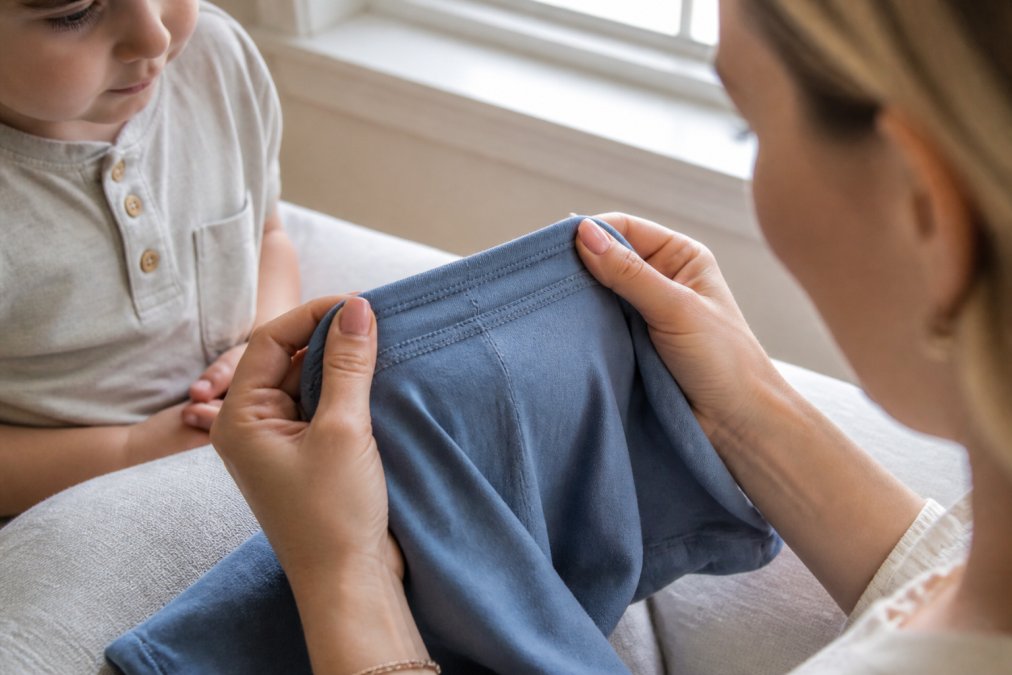
Fabric Weight and GSM: The Number That Predicts Wear
The single most reliable predictor of a fabric's durability is its weight, measured in grams per square meter (GSM). A standard, lightweight t-shirt might be around 120-150 GSM, while a heavier, more durable sweatshirt fabric, like a quality French terry, often falls between 240-300 GSM. Heavier weights resist tearing, pilling, and stretching out of shape far better than lighter counterparts.
Stitch Count and Seam Construction
Stitch count is the number of stitches per inch, and it's a direct window into construction quality. Higher stitch counts create stronger, flatter seams that are less likely to pop. A quality garment will have a high stitch density and a proper seam allowance, the extra fabric inside the seam that prevents unraveling. Look for reinforced seams, especially in stress areas.
Best Fabrics for Active Toddlers: What Actually Holds Up
When it comes to the best fabrics for active toddlers, the choice often comes down to natural fibers versus synthetics. Organic cotton is soft, breathable, and gentle on sensitive skin, making it a fantastic choice for base layers. However, 100% cotton can shrink and lose shape if not cared for properly. For play clothes that withstand serious wear, poly-blends combine cotton's comfort with polyester's durability and shrinkage resistance.
French terry is a mid-weight knit with loops on one side, making it warm, soft, and resilient for hoodies and joggers. Fleece lining adds warmth to outer layers. For jeans, denim weight matters; heavier denim lasts longer than lighter, stretchier versions.
How to Spot High-Quality Kids Clothing Before You Buy
Beyond the physical checklist, a garment's durability story is often written in its labels and certifications. While most guides treat these as chemical safety badges, they also signal construction standards that correlate with longevity.
What Certifications Actually Mean for Durability
The Global Organic Textile Standard (GOTS) is the most rigorous certification you'll encounter. It verifies organic fiber content and restricts harmful chemicals, but it also imposes processing criteria that often result in higher-quality yarns and tighter weaves. Similarly, OEKO-TEX Standard 100 tests for harmful substances, but also screens for colorfastness and abrasion resistance, two factors that directly affect how a garment survives repeated washing and playground slides.
Be precise about what these labels do not promise. GOTS does not guarantee reinforced knees, and OEKO-TEX does not certify seam strength. The label tells you about fabric quality and chemical profile; the seam inspection tells you about assembly. Use both together.
The Second-Hand Durability Assessment
The resale market is where durability knowledge pays off most dramatically. A used toddler wardrobe can save families hundreds of dollars annually, but only if you can spot the difference between 'gently worn' and 'nearly spent.' Add these checks to your standard inspection:
- Fabric pilling test: Rub the fabric surface briskly with your palm for ten seconds. Excessive pilling on a used garment means the fibers are already breaking down; it will not survive another season.
- Elastic integrity check: Gently stretch waistbands and cuffs. If the elastic doesn't snap back immediately or shows visible cracks, it's nearing the end of its functional life.
- Color transfer test: Dampen a white cloth and press it against printed areas. If color transfers, the print is unstable and will fade quickly in future washes.
- Zipper function: Work the zipper slowly. It should glide without catching. A zipper that snags now will fail completely within weeks.
- Hem and cuff condition: Look for fraying along the bottom hems and sleeve cuffs, these are the first places that fail on active toddlers.
The Cost-Per-Wear Calculation That Changes Everything
When evaluating any garment, new or used, run the cost-per-wear formula before committing. Divide the purchase price by the estimated number of wears. A $30 pair of reinforced-knee pants worn three times weekly for six months costs roughly $0.42 per wear. A $12 pair of thin jeans that tears after eight wears costs $1.50 per wear. The math consistently favors quality, but also reveals that a well-constructed used garment at $8 is the best value in children's retail.
Choosing Everyday Play Clothes for Active Kids
Every toddler destroys clothes differently, and the destruction pattern shifts dramatically between twelve months and four years. Understanding your child's current wear profile is the single most useful tool for choosing durable everyday pieces. Here is the age-specific breakdown.
The Crawling Stage (12-18 Months): Knee and Toe Warfare
During this phase, knees take the brunt of the damage. Crawling on hardwood, carpet, and outdoor surfaces grinds fabric fibers against abrasive textures, resulting in the classic 'crawler hole', a worn patch at the knee within weeks.
What to prioritize: Pants with reinforced knee panels or double-layer fabric in the knee zone. Look for brands that use a separate patch sewn into the interior of the knee rather than just a thicker weave, because the patch provides a second layer that distributes friction. Also check the toe area of footed pajamas and socks, reinforced toe seams are essential.
What to avoid: Lightweight cotton leggings and thin jersey pants. These fabrics have low GSM (often 120-150) and offer almost no abrasion resistance. They will fail within two to three weeks of active crawling.
The Early Walker Stage (18-24 Months): Seat and Hip Stress
As toddlers transition to walking, the damage zone shifts. Falling backward and sliding on bottoms puts repeated stress on the seat and hip seams. Diaper bulk also stretches waistbands to their limit.
What to prioritize: Pants with a generous rise and elastic waistbands that have at least 1.5 inches of give. Look for flat-felled or double-stitched side seams, because these take the most strain during falls. Reinforced crotch gussets are critical, they prevent the seam from ripping when your child squats and stands repeatedly.
What to avoid: Jeans with minimal stretch. Rigid denim without elastane will not accommodate the constant squatting motion of new walkers, causing seam failure at the hips within weeks.
The Active Play Stage (2-4 Years): Seam, Zipper, and Print Failure
Once your child is running, climbing, and hanging from playground equipment, the failure points multiply. Seams at the shoulders and underarms pop from stretching. Zippers break from rough handling. Screen-printed graphics crack and peel from friction.
What to prioritize: Garments with reinforced stress points, bar tacks at pocket corners, double stitching along the yoke and shoulder seams, and flatlock seams that lie smooth against the skin. For shirts, choose raglan sleeves over set-in sleeves; the diagonal seam distributes stress better during arm movement. For pants, look for articulated knees (pre-shaped bends) that reduce fabric strain during running and climbing.
What to avoid: Anything with large, stiff screen-printed graphics across the chest or back. These crack within ten washes and create stiff spots that catch on playground equipment. If you want prints, choose embroidered designs or small, flexible heat transfers.
Matching Fabric Weight to Activity Level
Use this quick reference to match fabric to your toddler's current stage:
| Activity Stage | Recommended GSM | Best Fabric Types |
|---|---|---|
| Crawling | 200+ | French terry, reinforced knit |
| Early walking | 180-220 | Cotton-poly blends, soft denim with stretch |
| Active play | 220-300 | Heavyweight jersey, canvas, twill |
The Fit Factor That Prevents Damage
Fit is not just about comfort, it is a durability variable. Clothes that are too tight stress the seams every time your child moves. Clothes that are too loose create fabric that catches on doorknobs, slides, and branches. The ideal fit allows full range of motion without excess material.
How to Maintain Toddler Clothes for Longevity
Even the most durable toddler clothes will fail prematurely if they're not cared for correctly. The washing machine is often the biggest culprit in garment degradation. Wash clothes in cold water, as hot water is harsh on fibers and can cause shrinkage and fading. Always turn clothes inside out before washing to protect the outer surface and preserve the print.
Air drying is the gentlest method and will extend the life of your garments significantly. The high heat of a dryer breaks down elastic, fades colors, and causes shrinkage. If you must use a dryer, use the lowest heat setting possible. Treat stains promptly before washing. Learn the basics of mending, a small hole in a seam is a five-minute fix with a needle and thread.
Durable Outerwear: A Case Study in Construction
Outerwear is where the principles of durable construction are most critical, as it faces the harshest conditions. The shell fabric should be water-resistant and wind-resistant, and the lining should be a warm, comfortable fleece. Details like elastic cuffs, a chin guard, and reinforced stitching at stress points are all signs of a garment built to last for more than one season.
We see this level of construction in our outerwear selection, such as the Weather Tamer Toddler and Little Girls Iridescent Foil Puffer Jacket, Size 2T. It features a water- and wind-resistant fleece-lined shell, elastic cuffs, and a full-length chin guard, all made from 100% polyester fleece. For older kids, the Eddie Bauer Youth 3-in-1 Jacket is a masterclass in versatility and value, offering a water-resistant outer shell and a warm, polar fleece inner jacket that can be worn together or separately. These pieces are designed with the specific intention of being durable, functional, and long-lasting.


Your Durability Game Plan: From Cart to Closet
Now here is the game plan for putting it into action. Start by auditing your child's current wardrobe. Which items have lasted, and which have fallen apart? This will tell you which fabrics and brands work best for your child's specific wear patterns. Use this information to create a shopping list of what you actually need.
When you shop, use the five-point checklist and don't be afraid to ask questions about fabric weight and construction. A reputable seller should be able to tell you about the GSM and materials used. Remember that the goal is to build a functional, sustainable wardrobe that makes mornings easier and keeps your kids comfortable and protected.
Finding durable toddler clothes that don't sacrifice style for strength is a challenge every parent faces. We believe you shouldn't have to choose between a cute outfit and one that survives the playground. At Tots & Trends by Morgan, we take the guesswork out of the equation by carefully curating a collection that meets our high standards for construction and longevity. Explore our selection of premium playwear and outerwear, and give your child clothes that are ready for anything. Get started with Tots & Trends by Morgan and build a wardrobe that lasts.
Frequently Asked Questions
What is the best fabric for toddler clothes?
For durable toddler clothes, look for fabrics with higher GSM (grams per square meter). Midweight options around 200-250 GSM, like French terry or fleece, resist wear better than flimsy knits. Organic cotton is softer for sensitive skin, but a poly-cotton blend often adds synthetic durability for high-wear areas like knees. For active play, prioritize fabrics that offer both fiber integrity and a tight weave.
How can I tell if a garment is high quality?
Check the construction, not just the label. Turn the garment inside out and look for reinforced seams with a high stitch count (8-12 stitches per inch). Ensure seam allowances are at least half an inch so they don't unravel. Pull gently on the fabric to test tensile strength and check for reinforcement patches in high-wear areas like the knees. These signs indicate how to spot high-quality kids clothing.
Are organic fabrics more durable for active toddlers?
Not always. Organic cotton is grown without harsh chemicals, making it better for sensitive skin, but its durability depends on the weave and weight. A heavy organic cotton or a blend with a small percentage of synthetic fiber (like spandex for stretch recovery) can be very durable. Look for a high GSM and reinforced knees rather than assuming 'organic' automatically means it will survive active play.
Do 2 year olds wear 2T or 3T?
Sizing varies by brand, but 2T generally fits toddlers around 2 years old (approximately 34-36 inches tall, 28-30 pounds). However, for durable toddler clothes that last, consider buying the next size up if your child is between sizes. This extends the garment's life, giving you a better cost-per-wear on higher-quality pieces.