

Last Updated: October 24, 2026
Quick Summary
PFAS in baby clothing are per- and polyfluoroalkyl substances, human-made chemicals applied as water- and stain-resistant coatings during manufacturing. Called forever chemicals because they don't break down naturally, PFAS can migrate from treated fabrics into your baby's skin and body, accumulating over time during critical developmental periods.
- PFAS-based finishes on water-resistant and stain-resistant baby clothing last 20-30 washes, while alternatives like wax-based treatments last only 5-10 wears.
- Infants are more vulnerable to PFAS exposure because their developing bodies and detoxification systems aren't fully mature.
- A PFAS-free label can be self-declared marketing, third-party certified, or backed by lab testing, each carries different levels of proof.
- Washing reduces surface residue but doesn't remove PFAS bonded into fabric during manufacturing; choosing untreated garments is more effective than washing.
- Prioritize untreated natural fabrics like organic cotton for base layers and items in frequent skin contact, especially during fall and winter when babies wear more treated outerwear.
Table of Contents
- What Are PFAS and Why They're Called Forever Chemicals
- How PFAS End Up in Baby Clothing and Textiles
- Understanding Water-Resistant Baby Clothing Chemicals
- Health Concerns: What Parents Should Know About Infant Exposure
- How to Avoid PFAS in Baby Products: A Parent's Checklist
- Choosing PFAS-Free Baby Clothes: What Labels Really Mean
- Finding High-Quality, Safer Clothing for Your Little One
- Frequently Asked Questions
What Are PFAS and Why They're Called Forever Chemicals
PFAS stands for per- and polyfluoroalkyl substances, human-made chemicals manufactured since the 1940s. They're called "forever chemicals" because they don't break down naturally in the environment or the human body, persisting and accumulating indefinitely.
These fluorinated chemicals are prized for repelling water and oil, making them useful for products that need to stay clean, dry, and stain-free.
Concern has grown as researchers document PFAS in drinking water, soil, human blood samples, and PFAS in baby clothing nationwide.
How PFAS End Up in Baby Clothing and Textiles
Textile manufacturers apply PFAS in baby clothing and children's garments to make them water-, oil-, and stain-resistant. The treatment is applied as a coating or finish during production, bonding to the fabric fibers.
Common applications include:
- Water-repellent finishes on jackets and outerwear
- Stain-resistant treatments on everyday play clothes
- Oil-repellent coatings on performance fabrics
- Wrinkle-resistant and easy-care finishes on cotton blends
The challenge is that PFAS treatments aren't always disclosed on labels.
Bedding, cloth diapers, and other textiles touching a baby's skin can also receive these treatments. Even items marketed as "natural" or "organic" may be treated with PFAS during finishing, after raw materials are sourced.
Understanding Water-Resistant Baby Clothing Chemicals
Water-resistant baby clothing relies on chemical treatments to repel moisture, most commonly PFAS-based durable water repellent (DWR) coatings that cause water to bead up and roll off fabric rather than soaking in.
Manufacturers favor PFAS for performance: these treatments are highly effective, durable through multiple wash cycles, and cost-effective to apply at scale, maintaining water repellency even after many washes.
However, alternatives to PFAS-based DWR finishes do exist:
- Wax-based water repellent treatments (biodegradable, less durable)
- Silicone-based coatings (break down faster, require more frequent reapplication)
- Polyurethane membranes (durable, but different environmental profile)
- Fluorine-free polymer alternatives (newer technology, still emerging)
The trade-off with non-PFAS alternatives is typically durability: a wax-based treatment may wash out after 5-10 wears, while a PFAS treatment lasts 20-30 washes. For parents buying expensive baby clothing, the longer-lasting PFAS finish can seem like better value despite the health and environmental concerns.
PFAS-based finishes dominate water-resistant baby clothing, but alternatives exist with different trade-offs.
Treatment Type |
Durability |
Key Characteristic |
|---|---|---|
PFAS-based DWR |
20-30 washes |
Highly effective, cost-effective at scale |
Wax-based |
5-10 wears |
Biodegradable, less durable |
Silicone-based |
Variable |
Breaks down faster, requires reapplication |
Polyurethane membranes |
Durable |
Different environmental profile |
Fluorine-free polymer |
Emerging |
Newer technology, still developing |
Health Concerns: What Parents Should Know About Infant Exposure
PFAS can migrate from treated clothing into the skin, especially in infants who spend extended time in close contact with textiles. Learn about best soft fabrics for sensitive skin specifically chosen to protect developing infant skin.
Once in the body, PFAS accumulate in organs and blood over time, compounding with each contact.
Research has documented PFAS in human blood samples, including in children, and in breast milk, suggesting maternal exposure can pass to nursing infants.
PFAS in a product doesn't automatically mean harm from a single exposure. But because these chemicals persist, repeated daily contact through clothing creates cumulative exposure over months and years during critical developmental periods.
How to Avoid PFAS in Baby Products: A Parent's Checklist
Reducing infant exposure to PFAS requires a practical approach to shopping and care, especially as colder weather arrives and babies spend more time in outerwear, buntings, and layered garments more likely to carry water- and stain-resistant finishes.
When shopping for fall and winter baby clothing:
- Look for brands that explicitly state "PFAS-free" or "fluorine-free" on product labels or websites, and ask whether the claim is self-declared, certified, or tested (see the label section above)
- Treat "water-resistant," "snow-resistant," and "stain-resistant" claims on jackets, buntings, and outerwear as signals to ask about the finish before buying
- Prioritize untreated natural fabrics (organic cotton, linen, wool) for base layers and items in frequent contact with skin
- For cold-weather outerwear, ask whether the water repellency comes from a PFAS-based DWR or a fluorine-free alternative (wax, silicone, polyurethane)
For items already in your closet:
- Wash new clothing multiple times before the first wear to reduce surface chemical residue
- Use mild detergents and avoid fabric softeners, which can add additional chemicals
- Air-dry clothing when possible rather than using high-heat dryers
- Rotate clothing regularly so no single item is worn constantly
A quick decision guide for a garment you already own:
- Is it a water- or stain-resistant jacket, bunting, or snowsuit? Assume a DWR finish is present unless the brand says otherwise; layer an untreated natural-fiber base layer underneath and reserve it for outdoor use.
- Is it an everyday bodysuit, sleeper, or legging? These are usually untreated; prioritize natural fibers and wash before first wear.
- Is it labeled "easy-care" or "wrinkle-resistant"? Ask the brand what finish was applied before deciding how often baby wears it.
- Is the finish unknown and the item heavily worn against skin? Weigh the cost of replacing it against the benefit of reducing cumulative contact.
Building a safer cold-weather wardrobe:
- Focus on basics in natural, untreated fabrics for daily wear and layering
- Reserve treated water-resistant items for outdoor occasions rather than everyday use
- Look for best non toxic kids clothing brands that prioritize chemical-free production
- Choose organic cotton baby outfits as a foundation for a safer wardrobe
A note on what washing can and cannot do:
Washing reduces surface residue but doesn't remove a finish bonded into the fabric during manufacturing. A PFAS-based DWR is designed to survive repeated wash cycles, which is exactly why it's used on outerwear.
Choosing PFAS-Free Baby Clothes: What Labels Really Mean
Label claims about water-resistance, stain-resistance, and easy-care finishes often signal PFAS or similar treatments. The harder question is whether a "PFAS-free" claim can actually be verified.
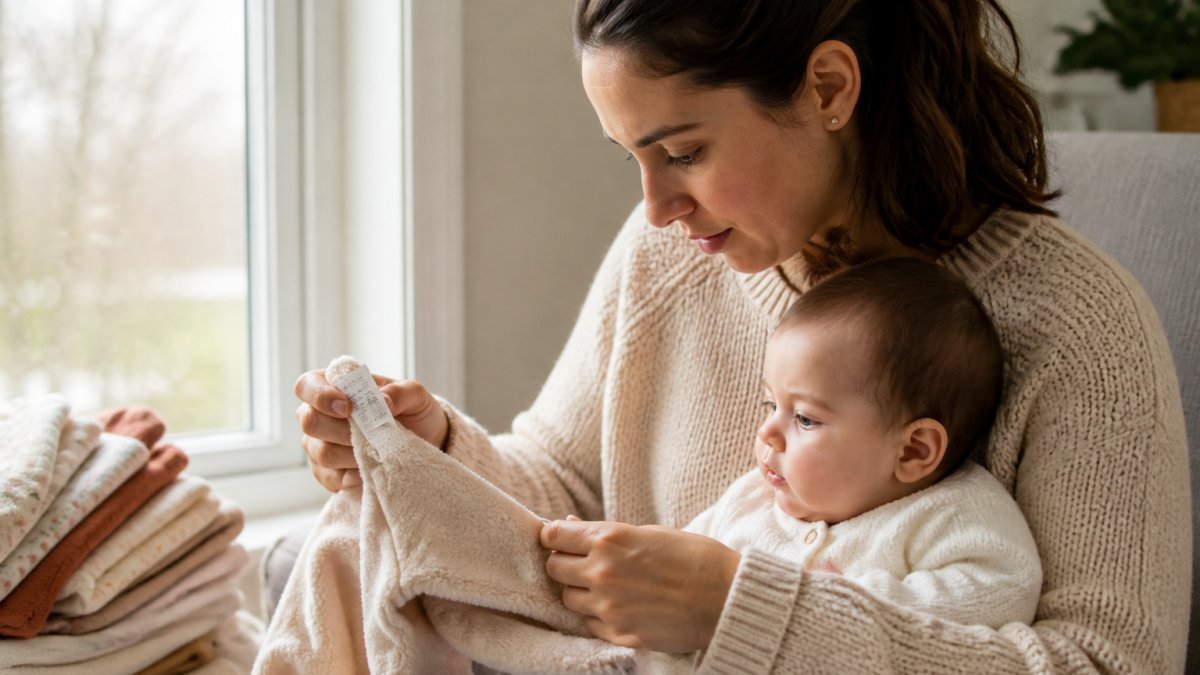
Common label terms and what they indicate:
- "Water-resistant" or "water-repellent" = likely treated with a durable water repellent (DWR) coating, often PFAS-based
- "Stain-resistant" or "stain-proof" = chemical finish applied to resist oil and water
- "Easy-care" or "low-maintenance" = often includes wrinkle-resistant or stain-resistant treatment
- "Performance fabric" = engineered with chemical finishes for specific properties
Three tiers of "PFAS-free" claims, and what each actually proves:
- Marketing claim (weakest). A brand states "PFAS-free" or "fluorine-free" on a hangtag, product page, or social post with no supporting documentation. This is a self-declaration. It may be accurate, but nothing independent backs it up, and the term "PFAS-free" has no single legal definition that applies uniformly across all products and states.
- Certification (moderate). A third-party certification or restricted-substance list is cited, such as a bluesign® APPROVED or bluesign® PRODUCT designation, an OEKO-TEX® STANDARD 100 certification, or a brand's participation in a restricted-substance program. These programs screen for many harmful substances and can restrict certain PFAS, but the scope varies by standard and by product class. A certification is stronger evidence than a hangtag, but parents should check what the specific standard actually covers rather than assuming it guarantees zero PFAS.
- Supply-chain or laboratory verification (strongest). The brand discloses its supplier-level chemical inventory, provides a signed supplier declaration, or publishes test results. Laboratory methods fall into two broad families: total fluorine screening, which measures how much fluorine is present in a sample and can flag that some fluorinated compound is there, and targeted PFAS analysis, which looks for specific named chemicals. Total fluorine screening can suggest a problem but cannot by itself identify which PFAS are present; targeted testing can confirm specific compounds but only those the lab looks for. Neither method proves a garment is entirely free of every PFAS variant, which is why "verified" is a matter of degree, not an absolute.
What genuine PFAS-free labeling tends to look like:
- Explicit statement: "PFAS-free," "fluorine-free," or "no per- and polyfluoroalkyl substances"
- A named certification with a registration or license number you can look up
- Disclosure of what treatment was used instead (wax, silicone, polyurethane, etc.)
- A clear statement that the item is untreated or naturally water-resistant
Questions to ask a brand before you trust the claim:
- Is your "PFAS-free" statement self-declared, certified, or tested?
- If certified, which standard, and does it cover the specific finish on this garment?
- If tested, was it total fluorine screening or targeted PFAS analysis, and what did the results show?
- Which supplier or mill provides the fabric, and can you share a restricted-substance declaration?
"Greenwashing" exists in children's clothing.
Parents should look for how to spot greenwashing in kids fashion to recognize misleading claims.
Finding High-Quality, Safer Clothing for Your Little One
Quality and safety don't have to be mutually exclusive.
High-quality baby clothing that avoids PFAS typically relies on:
- Premium natural fibers (organic cotton, merino wool, linen) that age well without chemical enhancement
- Thoughtful construction emphasizing durability over chemical resistance
- Simpler design that doesn't require stain- or water-resistant treatments
- Transparent sourcing and manufacturing practices
Explore best organic cotton baby outfits as a foundation for a safer, higher-quality wardrobe.
For parents building a sustainable approach, building a sustainable baby wardrobe covers how to select pieces that will last through multiple children, frequent washing, and everyday play without relying on chemical treatments to maintain appearance.
When shopping with Tots & Trends by Morgan, parents can explore carefully curated options that prioritize both style and safety.
What to prioritize in your search:
- Soft, natural fabrics that feel good against delicate skin
- Construction quality (strong seams, secure buttons, reinforced areas prone to wear)
- Neutral colors and classic styles that coordinate with other pieces
- Brands with transparent policies about fabric treatments and sourcing
Investing in fewer, higher-quality pieces that avoid unnecessary chemical treatments creates a wardrobe that's both safer and more sustainable.
Parents deserve clarity about what their children are wearing.
Frequently Asked Questions
What are PFAS in baby clothing?
PFAS, or per- and polyfluoroalkyl substances, are human-made chemicals used in fabric treatments to create water, oil, and stain resistance. Often called forever chemicals because they don't break down in the environment or your body, PFAS are applied to many baby clothing items, bedding, and textiles to make them more durable and easier to clean. Understanding where these chemicals come from helps parents make informed choices about what their children wear.
Why might manufacturers use PFAS-treated fabrics in baby products?
Manufacturers use PFAS treatments because they make fabrics water-repellent, stain-resistant, and wrinkle-free—qualities parents often seek in baby clothing. These durable water repellent finishes help garments withstand frequent washing and spills, which is especially appealing for everyday baby wear and bedding. However, this convenience comes with the trade-off of chemical exposure, which is why many parents now seek PFAS-free alternatives.
How can I tell if baby clothing contains PFAS?
Labels claiming water-resistant, stain-resistant, wrinkle-free, or easy-care properties may indicate PFAS treatments, though not always. Look for certifications like OEKO-TEX or eco-certifications that test for harmful chemicals. Check product descriptions for fluorine-free or PFAS-free claims. When in doubt, contact the manufacturer directly to ask about their fabric treatments. Natural fibers like organic cotton and untreated wool are generally less likely to contain these chemicals, though laboratory testing remains the most reliable verification method.
What's the difference between PFAS-free and fluorine-free labels?
PFAS-free means the product has not been treated with per- and polyfluoroalkyl substances specifically. Fluorine-free is broader and means no fluorinated chemicals were used at all. A fluorine-free product is always PFAS-free, but a PFAS-free label doesn't guarantee the absence of all fluorinated compounds. When shopping, look for both terms or ask manufacturers about their specific testing and chemical disclosure practices to ensure you're getting what you're looking for.
